2025 put Construction Owners under real pressure.
Schedules slipped. Budgets tightened. Approvals slowed. Reporting that once felt acceptable collapsed under scrutiny.
In this session, Director of Client Services, Mike Schwind, and Director of Implementation, Kaely Culbertson, exposed how 2025 was not a year defined by a single disruption. It was a stress test.
If you missed the live conversation, you can watch the full webinar recording HERE.
What did 2025 volatility expose for Construction Owners?
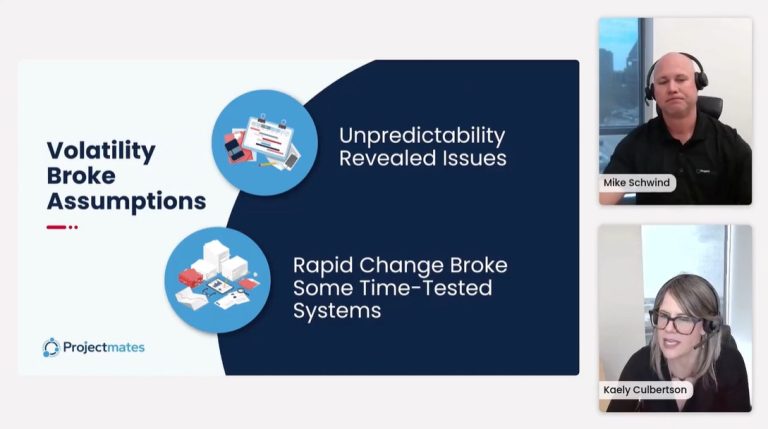
Labor shortages, inflation, tariffs, shifting financing, uneven market performance. None of that was new. What changed in 2025 was the frequency and speed of disruption.
Some sectors pushed forward aggressively. Others stalled or shut down entirely. Public work remained relatively stable while private projects showed higher abandonment rates. In that kind of environment, small gaps stopped being small. Minor delays compounded. Incomplete information snowballed. Rework, already costing the industry an estimated 4 to 10 percent of project value, became harder to contain.
The difference between programs that absorbed the pressure and those that buckled was not sophistication. It was visibility.
Teams with clear ownership, consistent workflows, and defensible data could explain what changed and why. Teams relying on manual workarounds spent their time chasing the present instead of managing the future.
Why did Owner expectations change in 2025?
One of the quiet shifts in 2025 was cultural.
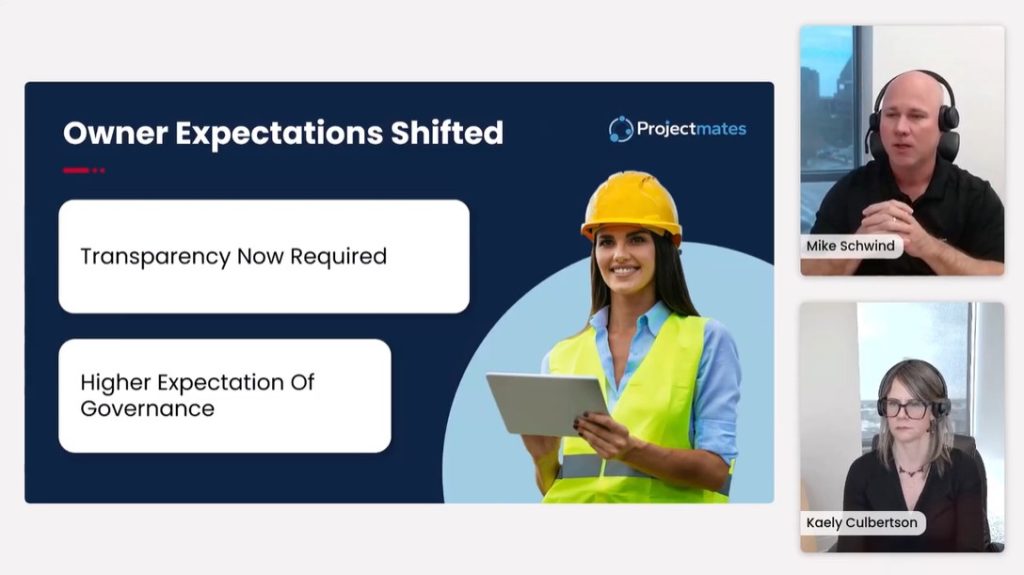
Leadership expectations changed. Executives did not just want updates. They wanted answers that held up under scrutiny. Transparency stopped being a nice-to-have and became a baseline requirement. Governance moved from theory to expectation.
Economic uncertainty sharpened that demand. When margins shrink, tolerance for vague explanations disappears. Owners were asked to justify decisions in real time, not after the fact. And that pressure flowed downstream into systems, workflows, and project teams.
Audit readiness, forecasting discipline, and accountability could no longer be retrofitted mid-project. Programs either had those foundations or they did not.
Where does AI actually help construction Owners and where does it add risk?
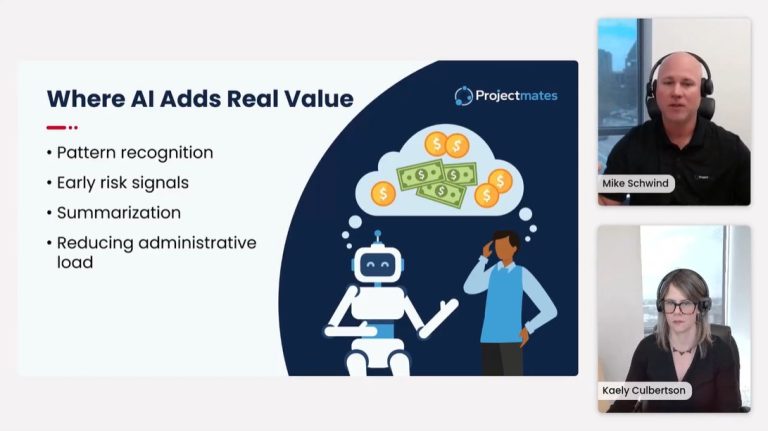
When pressure rises, industries look for acceleration. Right now, that acceleration is labeled AI.
The hype cycle is familiar. Big promises. Rapid adoption. Uneven results. The reality most teams discovered is that AI does not remove work. It changes where the work shows up.
Used well, AI behaves like a very fast junior analyst. It surfaces patterns. It flags anomalies. It summarizes activity. What it does not do is replace judgment.
AI cannot weigh tradeoffs. It cannot read political context. It cannot decide when a schedule slip is acceptable on one project and disastrous on another. It cannot own outcomes.
Most importantly, AI amplifies whatever already exists.
Structured workflows produce faster insight. Messy data produces confident nonsense. Garbage does not become wisdom just because an algorithm touched it.
This is where risk shows up. Poor inputs lead to poor outputs delivered with speed and confidence. Accountability blurs. Trust erodes. Not because AI failed, but because governance was never clear.
What practices helped Owners absorb disruption in 2025?
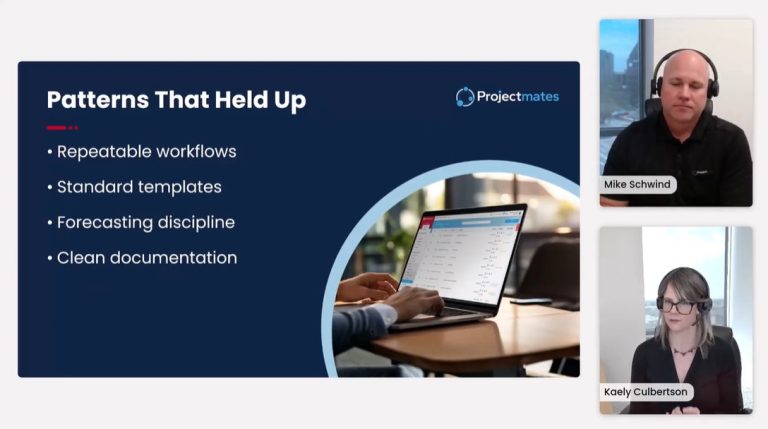
The patterns that held up in 2025 were not flashy.
Repeatable workflows. Standard templates. Forecasting discipline. Clean documentation.
These fundamentals were the difference between reacting and staying in control. Teams with repeatable workflows did not avoid disruption, but they absorbed it.
Consistency became a safety net in a tight labor market. When people left, the work did not walk out the door with them. New team members onboarded faster. Vendors received clearer signals. Quality stayed intact even as conditions shifted.
At scale, this showed up as reputation. Predictability. Confidence. Fewer downstream fixes. Shorter feedback loops. Less rework.
Structure did not eliminate change. It prevented change from breaking the program.
What should Owners plan differently for 2026?
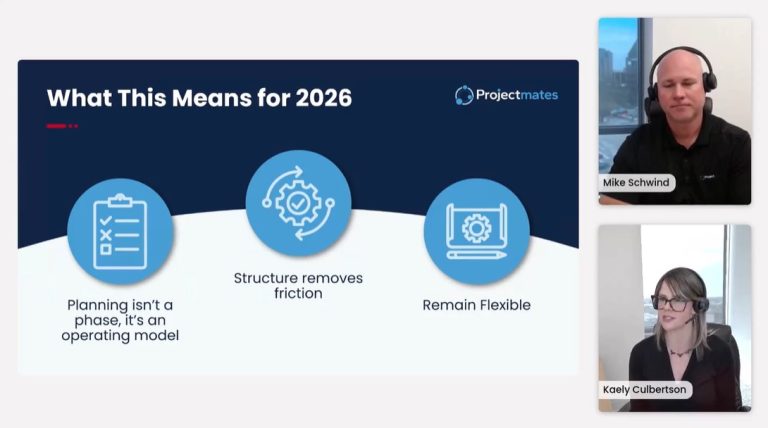
The biggest takeaway moving into 2026 is simple and uncomfortable.
Planning is no longer something you do at the beginning of a project. It is an operating model.
The teams that felt less pain in 2025 were not luckier. They were more structured. That structure gave them earlier signals, clearer ownership, and faster decisions.
It also gave them something else that matters now. Clean inputs.
Without clean data and defined processes, AI simply helps teams be wrong faster. With sound structure, it becomes a force multiplier for visibility and pattern recognition.
Expectations are not relaxing. Transparency is assumed. Governance is expected. Explanations after the fact are no longer enough.
Key takeaways for Construction Owners
- Volatility punished weak structure, not weak effort
- Visibility and ownership mattered more than speed
- AI amplified good systems and exposed bad ones
- Repeatable workflows reduced risk during staffing and market instability
- Planning now functions as an operating model, not a project phase
The question for Owners heading into 2026 is not which tool comes next. It is whether the foundations underneath those tools are strong enough to carry the weight.
Frequently asked Questions (FAQs)
2025 revealed that effort was not the issue. Structure was. Programs with weak workflows, unclear ownership, and fragmented data struggled under volatility, while structured programs absorbed disruption.
The speed and frequency of change increased. Teams relying on manual tracking and delayed reporting could not keep pace, which turned manageable risks into reactive decisions.
AI can improve outcomes only when paired with clean data and defined workflows. It accelerates insight but does not replace judgment, accountability, or governance.
AI adds risk when it is layered on top of messy data, undefined workflows, or unclear decision authority. In those cases, it produces confident outputs that are difficult to defend.
Owners should treat planning as an operating model, not a project phase. That means investing in repeatable workflows, clear ownership, clean data, and systems that surface early signals instead of after-the-fact explanations.