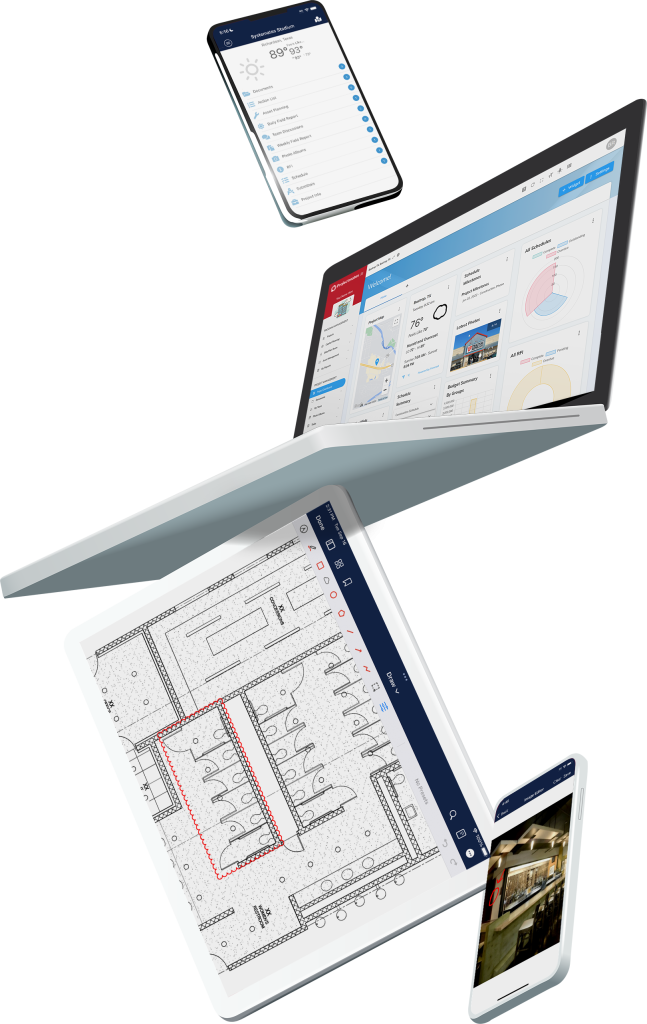
Managing construction project closeout means standardizing the punch list, documentation, and financial sign-off process before a project reaches its final phase, not scrambling to assemble it once construction wraps. Done well, it includes a defined checklist set at kickoff, real-time tracking of open items, centralized warranty and as-built documentation, and a standardized financial closeout workflow applied the same way across every project in a program.
Closeout is where a lot of well-run construction projects quietly fall apart. The schedule held. The budget held. And then the project sits open for months because nobody built a process for the last mile.
For Owners, that delay isn’t a paperwork inconvenience. It’s retainage tied up, warranties that don’t start their clock, and a capital program that can’t officially move on to the next thing until this one is actually finished. Even by conservative, long-standing estimates, the cost of this problem is real: a NIST study on the industry found inadequate interoperability and information handoff costs owners and operators an amount equal to nearly three percent of the annual value of construction they put in place. Facility management researchers are still writing about the same failure mode today, just without a number attached. That’s not a rounding error. It’s money lost to nobody being able to find the right document at the right time.
Why Does Construction Closeout Break Down?
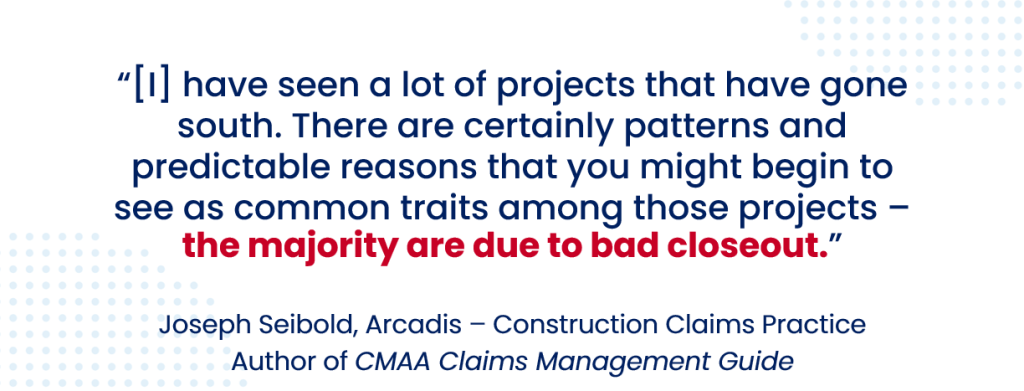
Closeout fails for reasons that have nothing to do with construction quality and everything to do with process gaps.
Documents scattered across email, shared drives, and paper files. By the time closeout starts, nobody has a single, reliable list of what’s outstanding. Finding the last submittal or the final as-built becomes a scavenger hunt.
No standard checklist across projects. Every project manager closes out a project their own way, which means every closeout takes as long as the least experienced person running it.
Punch list items with no clear owner or deadline. Items sit open because nobody is accountable for chasing them down, and there’s no automatic escalation when a deadline slips.
Warranty and as-built documentation handled as an afterthought. This is the information the Owner needs for the life of the building, and it’s often assembled in a rush at the very end instead of collected as the project goes.
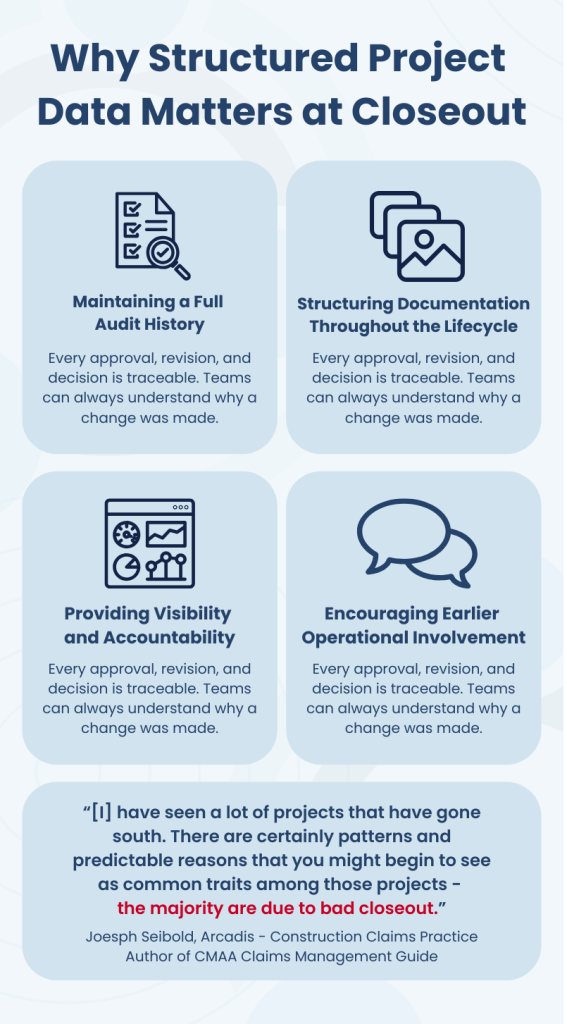
Facilities and operations brought in too late. When the team that will actually run the building isn’t involved until handover, they inherit files instead of context. A substitution made mid-construction, a controls sequence explained only in a commissioning report, a decision buried in an old email thread: none of it means anything to the person troubleshooting an alarm two years later if nobody preserved the reasoning behind it.
How Do You Build a Construction Closeout Checklist?
The single biggest lever an Owner has is defining the closeout checklist at project kickoff, not at project end. That means a standard list covering punch list completion, final inspections, warranty documentation, as-built drawings, O&M manuals, and financial closeout, applied the same way across every project in the program.
Standardizing this once means every project manager is working from the same definition of “done,” instead of improvising one at the finish line.
A standard closeout process generally follows these steps:
- Define the closeout checklist and required documentation at project kickoff.
- Track punch list items with a named owner and due date for each.
- Collect warranty, as-built, and O&M documentation throughout construction rather than at the end.
- Route final payment applications, retainage release, and lien waivers through the same standardized approval workflow used elsewhere in the project.
- Verify every checklist item is complete and documented before marking the project closed.
How Do You Track Punch List Items During Closeout?
A punch list item without an owner and a due date is just a wish. Every open item needs someone responsible for it and a deadline attached, with automatic follow-up when that deadline passes. This is where most closeouts lose weeks: not because the work itself takes long, but because nobody was tracking who owed what.
How Should Closeout Documentation Be Managed?
Waiting until the end to assemble warranty documents, as-builts, and O&M manuals guarantees a scramble. The fix is collecting this documentation throughout construction, so closeout becomes a verification step instead of a document hunt. A centralized record also means the Owner has one place to pull from years later when a warranty claim or a facilities question comes up.
What Does Financial Closeout Involve?
Final payment applications, retainage release, and lien waivers all need the same standardized workflow as any other approval in the project. Treating financial closeout as a formality, rather than a controlled process, is exactly how funds stay tied up longer than they should.
Closeout Is Part of the Program, Not an Afterthought to It
The projects that close out fastest aren’t the ones with the least complexity. They’re the ones where closeout was built into the process from day one instead of bolted on at the end. Owners who standardize this across every project in their program get retainage released faster, get their warranty documentation in one place instead of scattered across a dozen inboxes, and get a program that actually keeps moving instead of dragging a tail of half-closed projects behind it.
The City of Waco lived the before-and-after version of this. Before adopting a centralized system, the city’s construction records were scattered enough that finding the latest version of a document meant real time lost, project after project. Once documentation and workflows moved into one platform, that same information became something the team could locate in minutes instead of days.
Common Questions About Construction Closeout
What is construction project closeout? Construction project closeout is the final phase of a project, covering punch list completion, final inspections, warranty and as-built documentation, and financial sign-off, before a project officially transfers from the construction team to the Owner and operations.
How long should construction closeout take? There’s no universal standard, since it depends on project size and complexity. Owners who standardize the checklist and track it in real time consistently close out faster than those assembling documentation and approvals after the fact.
Who is responsible for construction closeout? Responsibility is typically shared between the general contractor, who compiles and submits documentation, and the Owner’s project team, who verifies and approves it before the project is officially closed.
Why does construction closeout get delayed? The most common causes are scattered documentation, punch list items without a clear owner or deadline, and warranty or as-built records assembled late instead of collected throughout construction.
Projectmates gives Owners a standardized closeout workflow, from punch list tracking to warranty documentation to financial closeout, so the last phase of a project is as controlled as the first.