Closeout feels like a victory.
The contractor moves on. The PM team wraps up the project. Then, the operations team inherits the building.
However, if you haven’t handled the transition to operations correctly, the project may be complete, but your new asset is already carrying risk.
The Operational Risk of a Poor Handover
When handover packages are incomplete, scattered across email threads, or missing historical context, the consequences don’t show up immediately. They show up months later, when something breaks and no one remembers why a decision was made.

Imagine a technician troubleshooting an equipment alarm in a hospital. The documentation exists somewhere in the turnover package, but it was delivered as thousands of PDFs with no connection to the actual assets in the facility system. Hours are spent hunting down manuals that should have been linked to the equipment record from day one. By that point, subcontractors have already moved on to their next job. The general contractor is chasing down manuals, warranties, and as-built updates after the people who installed the equipment are no longer on site. And even when the documentation exists, the decision history is often missing.
During construction, substitutions happen constantly. A lighting control system might be swapped because of supply chain delays. The change order gets approved, but the discussion explaining why the substitution was acceptable is buried in an email thread. Two years later, when the facilities team replaces a component and discovers compatibility issues, the reasoning behind that decision is gone.
That’s not just inconvenient. It’s operational risk.
Without clean documentation and decision history, Owners lose:
- Accountability
- Warranty leverage
- Speed in troubleshooting
- Confidence in capital planning
Managing the asset becomes reactive instead of strategic.
Closeout Is the Bridge to Asset Management
We tend to treat closeout like an administrative checkpoint. In reality, it’s the bridge between capital delivery and long-term asset performance.
If that bridge is weak, asset management suffers for years.
Asset management systems depend on structured, reliable data. They don’t just need PDFs.
They need:
- Verified as-builts
- Connected warranties
- Approved submittals
- Documented change history
- A clear audit trail of decisions
When operations teams are brought in too late, they inherit files instead of insight.
Public sector Owners see this problem all the time.
A city’s public works department completes a new municipal facility. The construction team delivers the closeout package on schedule. Thousands of pages of documentation are technically provided. But the facilities staff responsible for maintaining the building were never involved during design or construction.
Six months later, a mechanical issue surfaces in the building automation system. The documentation exists, but the controls sequence explanation is buried in commissioning reports and contractor emails. The staff responsible for the building spend days reconstructing the logic behind the system instead of solving the problem. Over time, these small gaps compound. Maintenance becomes reactive, institutional knowledge disappears, and the asset never performs the way it was intended. The most forward-thinking Owners avoid this situation entirely. They involve operations during design and delivery.
They ask questions early:
Will this data structure work in our asset management system?
Are we capturing warranty terms in a usable way?
Are we tracking decision history in a way someone can understand two years from now?
That mindset shifts closeout from a scramble to a structured transition.
Doing Turnover Right Requires More Than a Checklist
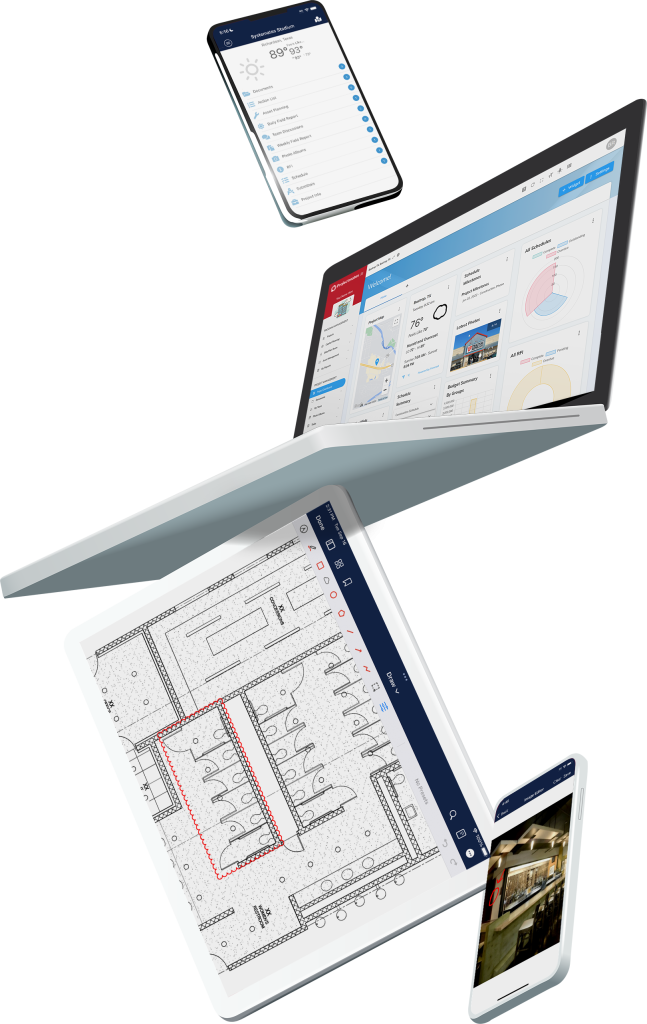
This is where leveraging a PMIS like Projectmates plays a larger role than many realize.
Turnover doesn’t start at substantial completion. It starts on day one.
When documentation, workflows, and approvals are centralized from the beginning, the system becomes a living record of the project. Not just files, but context.
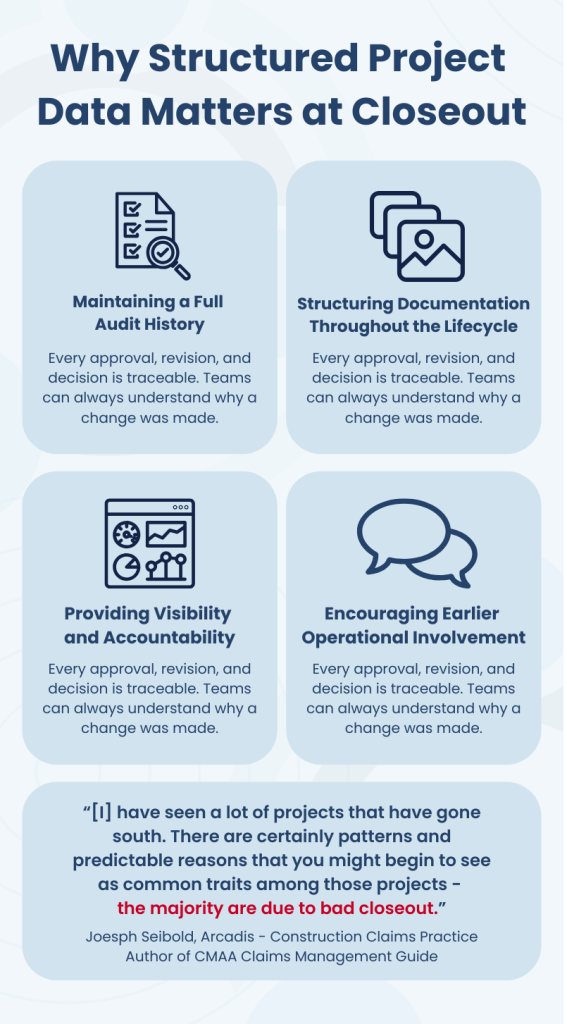
Maintaining a full audit history
Every approval, revision, and decision is traceable. When operations needs to understand why a material changed or why a scope adjustment was approved, the history is there.
Structuring documentation throughout the lifecycle
As-builts, submittals, warranties, and photos aren’t dumped in at the end. They’re captured and organized in real time, reducing the last-minute scramble that often defines project closeout.
Providing visibility and accountability
Stakeholders know what’s required for closeout. Gaps are visible early, not discovered during turnover.
Encouraging earlier operational involvement
Because information is centralized and accessible, facilities teams can engage before handover. That reduces friction and builds continuity.
When the system carries the history of the project, turnover becomes a transfer of trust, not just documents.
You spend millions delivering capital projects.
The last thing you should accept is losing institutional knowledge at the moment of turnover.
In other words, asset acceptance is where a finished project graduates into a fully informed asset.