What to Look for in Higher Education Construction Management Software
When a university takes on a new construction project, it’s not a simple endeavor. From labs and libraries to residence halls and sports facilities, the scope often mirrors the complexity of municipal projects. The stakes are high: students expect modern learning spaces, faculty need reliable infrastructure, and leadership must deliver these projects on time and within budget. Choosing the right construction management software isn’t just a matter of convenience. It’s a strategic decision that shapes how well an institution can execute its capital plan.
The best platform should simplify the work, reduce risk, and adapt to the unique way your institution operates. It has to handle the realities of higher education: tight budgets, public accountability, and the need to coordinate across a wide range of stakeholders. With that lens in mind, here are some of the most important considerations for universities evaluating their options.
Why Universities Need to Move Beyond Spreadsheets in Construction Projects
Many university project managers still manage projects using spreadsheets and paper-heavy processes. It feels cheap, but the hidden costs stack up quickly. Human error is inevitable when multiple staff members are updating the same spreadsheet, often resulting in duplicate entries or mismatched formulas. Project managers spend hours reconciling numbers instead of focusing on actual project execution. Worse, decision-makers often rely on outdated or incomplete information because the data isn’t updated in real time.
This way of working also creates fragility. If a single staff member leaves or a file gets corrupted, entire records can be lost. In contrast, modern construction management software centralizes budgets, schedules, documents, and progress tracking in a secure environment. Project managers gain real-time visibility, and leadership gets reliable reports that drive confident decisions. It’s all about protecting the institution from risk and enabling smarter capital planning.
How Construction Software Adapts to Campus Workflows
Every institution manages construction differently. Some rely heavily on in-house project managers, while others engage outside consultants. Some projects are funded entirely by the university, while others involve complex financing arrangements. No single software configuration fits every scenario. That’s why adaptability is critical.
The right platform should conform to your workflows rather than forcing your teams into rigid templates. For example, if your accounting department already relies on a specific enterprise system, your construction platform should integrate seamlessly rather than creating parallel processes. Automated workflows for tasks like approvals, change orders, or progress tracking reduce bottlenecks and keep projects moving without unnecessary administrative drag.
Think about the scale of projects in higher education: one month you might be modernizing a dorm, and the next you’re managing the construction of a new performing arts center. A platform that scales across project sizes and types ensures consistency and accountability across the entire portfolio. Action lists and task assignments give project managers clear visibility into responsibilities and timelines, improving organization and helping projects stay on track.
Reporting Tools That Give Higher Education Real Transparency
In higher education, transparency is non-negotiable. Trustees, finance officers, and even the public often want visibility into how projects are progressing. Leaders don’t need another binder of static reports; they need real-time insights that can be accessed at a glance.
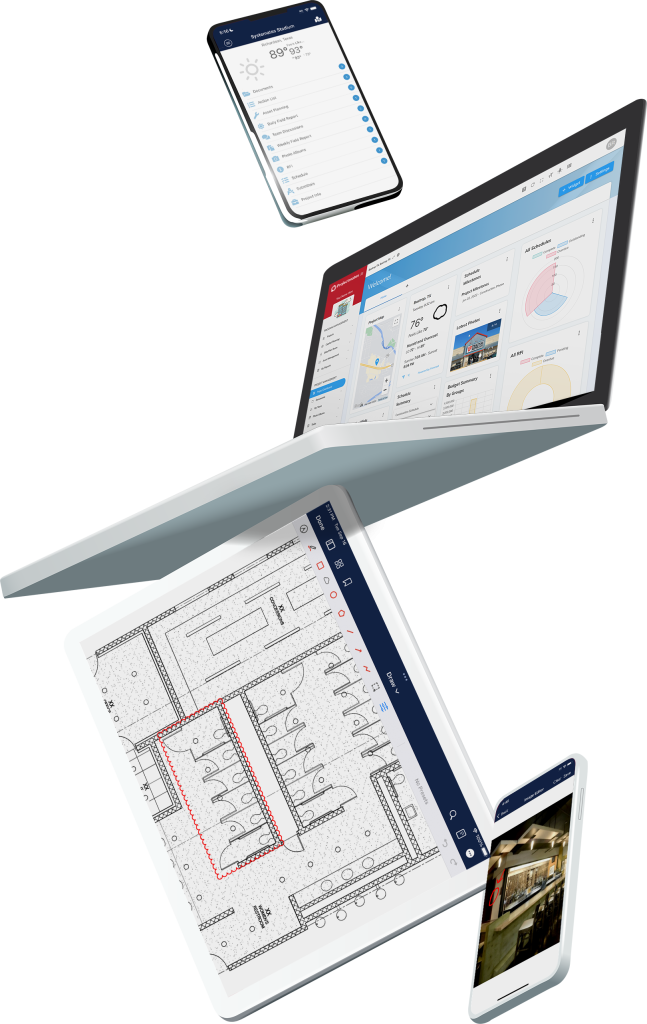
Dashboards and dynamic reporting tools provide exactly that. With a strong platform, project managers can track health indicators like budget variance, schedule adherence, and outstanding tasks. Executives can drill down to understand where risks are emerging and where interventions are needed. Mobile access ensures decision-makers can stay informed even when traveling. This level of visibility strengthens trust across the institution, from the boardroom to the facilities team.
Training and Adoption: Making Construction Software Work for University Teams
Software adoption is often where projects stumble. A university can purchase the most powerful system available, but if staff find it confusing or cumbersome, adoption will stall. Training makes the difference between a costly piece of shelfware and a transformative platform.
Effective programs go beyond simple onboarding. They mirror real-world scenarios that project managers actually face, from submitting a change request to generating a budget forecast. Training should be accessible on both desktop and mobile devices, accommodating dispersed teams and varying schedules. As the software evolves, ongoing learning opportunities keep teams aligned with new features and best practices.
The payoff is faster adoption, higher confidence, and a smoother path to seeing measurable return on investment. In an environment where capital projects already strain resources, that kind of acceleration is invaluable.
Archiving and Backup: Protecting Decades of Campus Project Data
Universities accumulate decades of project data, and much of it needs to be preserved. Accreditation reviews, financial audits, and legal disputes all require access to detailed records. Paper-based archives are cumbersome, prone to loss, and expensive to maintain.
A strong construction management platform makes backup and archiving seamless. Entire projects can be snapshotted at any point in time, creating a complete digital record that is easy to search and retrieve. This level of recordkeeping creates a safeguard against potential liability and a foundation for institutional memory.
When a facilities director retires or a project manager moves on, the knowledge they carried doesn’t disappear. The digital archive preserves that continuity, ensuring new staff can step in with a clear understanding of past decisions and project histories.
The Takeaway: Choosing Construction Management Software for Higher Education
Construction management software for higher education needs to deliver more than a checklist of features. It should be robust enough to manage large-scale capital projects, flexible enough to integrate with existing systems, and intuitive enough for teams to adopt without resistance.
When platforms bring together planning, design, construction, and turnover in one collaborative environment, universities can reduce delays, control costs, and improve accountability. The benefits ripple outward: students learn in better facilities, faculty teach in more reliable environments, and the institution strengthens its reputation for execution.
A campus built on strong foundations, both physical and digital, is better positioned to serve its community well into the future.